
Abjad is a method of calculation in which each letter of the Arabic alphabet is assigned a numerical value. Thanks to these values carried by the letters, a word, a name, or a verse can also be read as a number. Personal abjad calculation involves revealing these values based on the person's and their mother's names, thereby preparing a sound foundation for vefk (magic square) and Asma al-Husna studies.
What is the Science of Abjad?
It is narrated that the arrangement of Arabic letters according to the abjad order dates back to Adam (peace be upon him). It is known that this system passed from Nabataean to Arabic, influenced also by Hebrew and Aramaic, and was used during the time of the Prophet (peace and blessings be upon him). Over time, the numerical values assigned to the letters were accepted by scholars, men of letters, and poets; important dates were recorded using these values. Thus, the method developed, becoming almost a subsidiary science of the Arabic alphabet, and was referred to as "abjad calculation," "the science of abjad," or "the science of jafr."
There are narrations stating that this science was also present in the books of the ancient prophets. Some scholars said, "Only the Mahdi, who will come in the end times, will fully comprehend this science." It must be stated from the outset: Abjad calculation is not a means of discovering the future. The future lies in Allah's knowledge, will, and power; unless He reveals it, no one can know what tomorrow holds through any calculation.
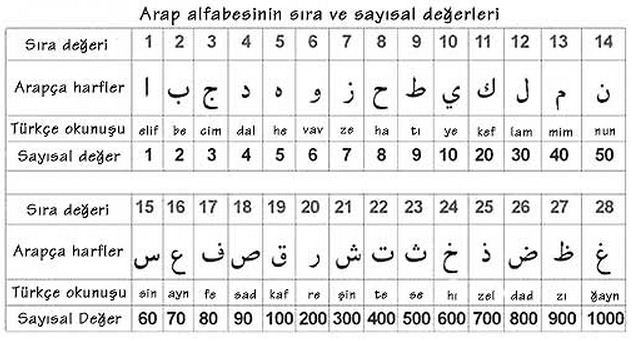
As a beautiful coincidence, the numerical value of "Abu Jad," the original name of the system, is 17; the number of people who knew how to write in Mecca at the time of Islam's emergence was also 17. The numerical values of the letters are as follows:
This science is not one that was forbidden and prohibited by the Prophet (peace and blessings be upon him).
Jafr, Great Abjad, and Small Abjad
Although the science of jafr was used for purposes other than its intended ones by some Jewish and Christian scholars before Islam, great figures such as Ali, Ja'far al-Sadiq, Muhyiddin Ibn Arabi, Imam Ghazali, and Bayazid Bastami used it for good deeds and directed it toward its true purpose after the advent of Islam.
Before Islam, the abjad letters were used among the People of the Book as twenty-two letters. Islamic scholars added six more letters to complete the 28 letters that constitute the entirety of the Quranic alphabet. Later, some scholars who dealt with Havass and talismans calculated the abjad in two ways, revealing the coincidences of certain verses; these two methods were named "Great Abjad" and "Small Abjad."
Although it is pronounced "cifir" in Turkish, the original Arabic word is "jafr," which means "small calf." The reason for this name is that Ali (may Allah be pleased with him), or according to another narration, Ja'far al-Sadiq, wrote the fundamental plan of this science on the skin of a small calf.
It is narrated that the Prophet (peace and blessings be upon him) answered Jewish scholars who asked him questions using this science, and that he subtly alluded to abjad and jafr in his hadiths. The meaning of a narration encouraging the use of abjad is as follows:
"Learn the abjad and its interpretation! Woe to the ignorant scholar!.. Alif is Allah and Ilallah. Yahud is a letter from the name Allah. 'Ba' is Allah's creation and origination. 'Jim' is Allah's splendor. 'Dal' is Allah's religion."
Historical Examples of Abjad
The Conquest of Istanbul and Akshemseddin
During the days when the siege dragged on, Mehmed the Conqueror gathered his viziers, commanders, and scholars for consultation. Some of the scholars said, "Your Majesty, according to narrations, only the Mahdi will conquer this city; let us lift the siege." Akshemseddin asked for a day's grace; he consulted the sources and entered into spiritual contemplation. The next day, he said, "Your Majesty, the conquest of this city will be granted to you; do not lift the siege."
When asked for evidence, he gave this answer: "The phrase 'Beldetun tayyibatun' (Saba, 34:15) in the Noble Quran directly points to Mecca. Its 8 letters without shadda indicate that it would be conquered in the 8th year of the Hijra, and this indeed happened. This is the second city, after Mecca, that our Prophet promised would be conquered by a 'beautiful army and beautiful soldiers.' This expression equals 857 without shadda according to abjad calculation. This year is also the Hijri year 857." When reminded of the hadith about the Mahdi, he stated that the hadith was true, but that at that time the city would fall into the hands of the Dajjal, and the Mahdi would recapture it with tasbih and takbir.
The siege continued, and Istanbul was conquered. It is narrated that Mehmed the Conqueror said, "I am happier about having a scholar like Akshemseddin among us than about the conquest of Istanbul itself." If one pays attention, Akshemseddin did not predict the future; he did not say, "I say this"; rather, by saying, "I understand this from this sign in the Quran," he demonstrated a subtlety of the Quran's miraculous nature through the path of abjad.
The Dimensions of Mimar Sinan
Mimar Sinan frequently incorporated abjad values into the dimensional order of his works. In the Süleymaniye Mosque, the height from the ground to the springing level of the dome is 45, and the finial of the dome is 66 cubits high; according to abjad, "Adam" equals 45, and "Allah" equals 66. In the Selimiye Mosque, the diameter of the circle passing through the centers of the 8 pillars supporting the dome is 45 cubits; the edge of the dome is 45 cubits from the ground, and the finial of the minaret is 66 cubits from there. The visible silhouette of both mosques is 92 cubits, which corresponds to the name "Muhammad."
The Age of Rumi
It is narrated that when Rumi was asked his age, he replied, "I am one year younger than Huda; go ahead and calculate and find it!" Huda = (Ha) 600 + (Dal) 4 + (Alif) 1 = 605; according to this narration, Rumi was born in the Hijri year 604. His death is expressed by the word "Ibret": (Ayn) 70 + (Ba) 2 + (Re) 200 + (Te) 400 = 672.
Abjad in the Science of Vefk
Abjad and jafr have been used in the science of vefk (magic square), the science of stars, and chronological dating. The most common area of use is chronological dating: A skillful word or verse is composed to indicate the date of an event, and when calculated, that date emerges. This art, sustained throughout Divan literature, was also featured in inscriptions.
According to the researcher of Islam and Sufism, Prof. Annemarie Schimmel, the three-digit square known as "muthallath" (magic square), in which the sum of all horizontal, vertical, and diagonal rows is 15, has a very widespread place in the Islamic tradition. The letters contained in this square are "B-T-D-sharp Z-H-J-W-alif-dotless H". There is a widely held belief that these nine letters, sometimes written as themselves and sometimes as their abjad values, were first revealed to Adam (peace be upon him) as revelation. Their values in groups of three are as follows: 2+9+4=15, 7+5+3=15, 6+1+8=15.
This square was also accepted by Imam Ghazali, who stated that "its effect as a talisman has been proven by experience," and over time it became known as "Ghazali's Square" (Muthallath al-Ghazali). Ali (peace be upon him) also used these letters in his supplication in the Qasida al-Jaljalutiyya, saying: "Bi sirri buduhin echezatın /betadin zehecin bi vahi'l-vehâ.."
Qasida al-Jaljalutiyya
The Qasida al-Jaljalutiyya, the most famous qasida of Ali (may Allah be pleased with him), is arranged from beginning to end using abjad and cifr numerology. The qasida, which begins with the phrase "Bede'tu bi bismillah," ends with the following couplet indicating Ali's name: "Makalu Aliyyin ve'bnu ammi Muhammedin ve sirru ulûmin lil-halaiki cümmiat." Its meaning is: "These are the secrets of the sciences gathered for creation, and they are the words of Ali, the nephew of Muhammad (peace and blessings be upon him)." For this reason, scholars have referred to abjad calculation as "the key to secrets."
Examples of Concordance (Tevafuk) in the Noble Qur'an
There are many subtleties in the words, sentences, and composition of the Noble Qur'an. Since there are traces of miracles in the truths indicated by the verses and words, it is not surprising that there are signs in the letters that constitute them.
- "Allahumme Malike'l-mülk" (Al-Imran, 3/26): The number of repetitions of the names "Allah" and "Malik" up to this verse is 319; the abjad value of the phrase is also 319; and the verse containing the phrase is the 319th verse of the Qur'an. In the language of concordance (tevfuk), it is indicated that Allah, the Owner of sovereignty, is also the Owner of the Qur'an and knows it letter by letter.
- "Innaka le mine'l-mürselîn": This verse, meaning "Indeed, you are of the messengers," appears in two places in the Qur'an (Al-Baqara, 2/252; Ya-Sin, 36/3). The number of letters in the sentence (excluding the non-pronounced wasl hamza) is 13; its abjad value is 611, which is 47 times 13. This corresponds to the year 611 AD, when the Prophet (peace and blessings be upon him) was sent as a prophet.
- "If We take you away…": This sentence, addressed to the Prophet (peace and blessings be upon him), appears in three places: Yunus 10/46, Ar-Ra'd 13/40, and Ghafir 40/77. The sum of the verse numbers is 163, and the sum of the surah numbers is 63; 63 is the lifespan of the Prophet. The number of letters in the sentence is 9, and 63 is 7 times 9. The abjad value of the sentence is 632, which is the AD year of his death.
Every word and every letter of the Qur'an has been chosen by Allah's knowledge and will, with specific purposes and meanings. Not everyone can perceive these broad and subtle meanings to the same degree; some attain them through intellectual strength, some through spiritual strength, and some through Allah's grace. It is not a correct attitude to reduce the Qur'an and hadiths solely to their apparent meanings and to disregard the subtle meanings and those qualified to understand them.
Personal Abjad Calculation
In personal vefk (magic square) and Asma al-Husna studies, the first step is the correct calculation of the abjad value of the name and the mother's name. You can write to us via WhatsApp at 0547 953 63 63 to have your calculation done or to ask about a topic.
The information on this page has been transmitted from classical sources; no work carries a promise of results and does not replace medical diagnosis/treatment.